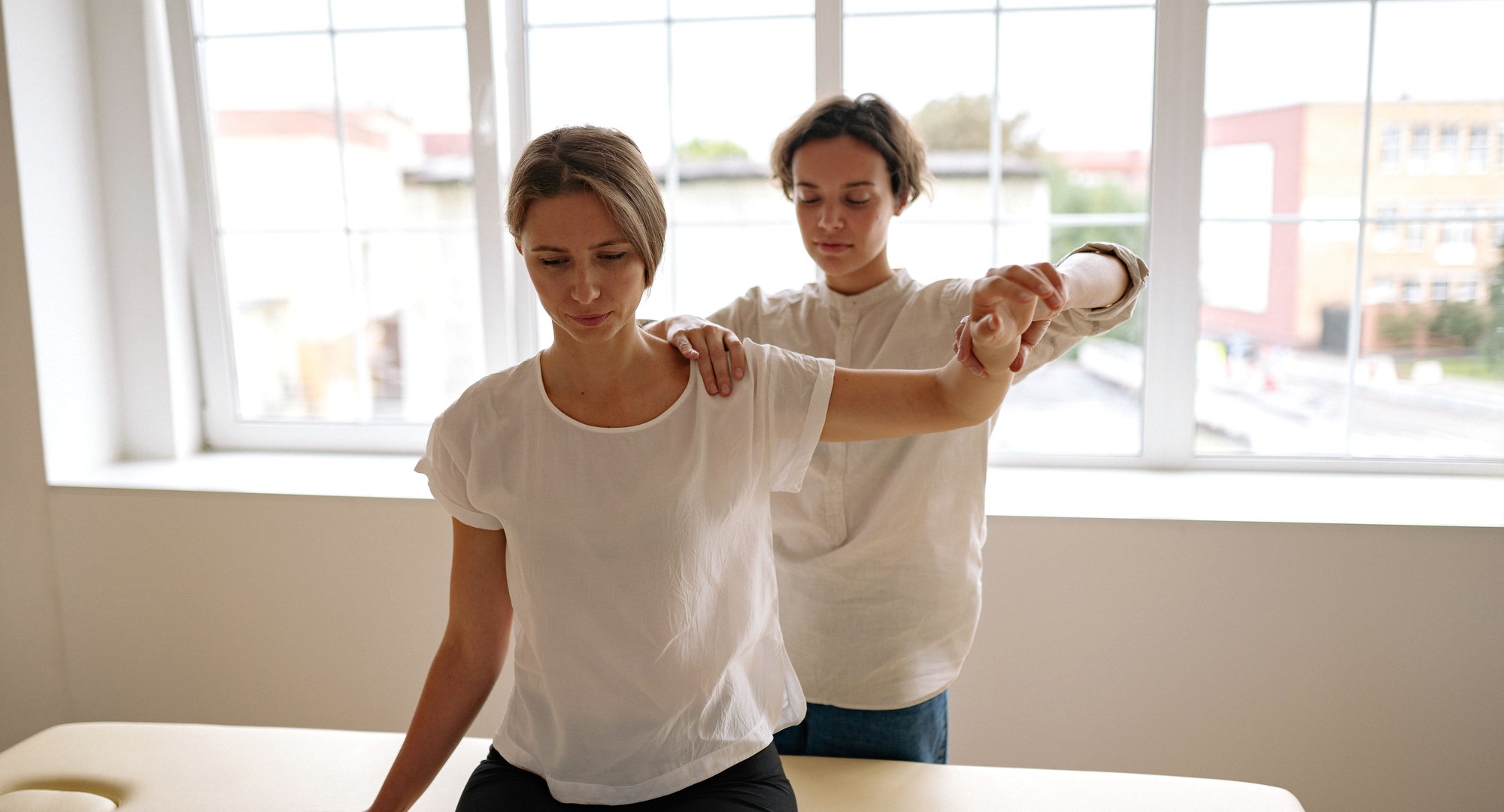
Physiotherapists are in demand across Germany, and the profession sits close to the patient every single day. What changes most for colleagues arriving from abroad is the frame around the treatment: the prescription that starts it, the minutes it may last, and the paperwork that accompanies it. And one thing turns out to be bigger than expected — how much of the job is explaining, in words a patient actually follows.
- Treatment starts with a Heilmittelverordnung
- Prescription first: what that means day to day
- The clock: 15 to 25 minutes
- Documentation on the prescription itself
- Certificates that unlock treatments
- The Therapiebericht goes back to the doctor
- Explaining and instructing: the real language test
- Home visits and the practice team
Treatment starts with a Heilmittelverordnung
In the statutory system, physiotherapy begins with a prescription from a doctor: the Heilmittelverordnung. It names the diagnosis, the Heilmittel (for example KG — Krankengymnastik, MT — Manuelle Therapie, MLD — Manuelle Lymphdrainage), the number of sessions and the frequency per week.
You work inside that frame. If the patient needs something different, the route runs back through the doctor — usually with a short written note from you.
KG · KG-Gerät · MT · MLD · KMT · Wärme/Kälte — knowing them by sight saves time from your first day.
Prescription first: what that means day to day
Direct access — a patient walking in and being treated without a doctor's prescription — exists in Germany for self-payers and private patients, and through the sektoraler Heilpraktiker qualification. For patients in the statutory insurance system, the prescription route is the standard one.
Colleagues from countries with broad direct access describe this as the clearest structural difference. In practice it shifts part of the clinical decision to the doctor and gives your Befund a different role: it documents, it guides the treatment, and it feeds back.
The clock: 15 to 25 minutes
A KG session in the statutory system is normally scheduled at 15 to 25 minutes, MLD according to its own time bands. That is shorter than in several other countries, and it changes how a session is built: less introduction, a clear focus, and instructions the patient can carry home.
Which is exactly why the language matters so much here. In twenty minutes, a sentence that has to be repeated three times is expensive.
Documentation on the prescription itself
Each session is confirmed on the Verordnung — date and signature. Alongside it, the practice keeps its own documentation of Befund, treatment and progress. For billing with the health insurers, completeness of that paperwork is what counts.
The vocabulary is small and repetitive: Befund, Behandlungsverlauf, Wiederbefund, Abschluss. It is learnable in a week and it appears in every working day afterwards.
Certificates that unlock treatments
Some Heilmittel may only be billed with an additional certificate: Manuelle Therapie, Manuelle Lymphdrainage, Bobath, KG-ZNS and others. They are acquired in courses after your qualification.
For internationally trained physiotherapists this is worth planning early: your recognition covers the profession, and the certificates then open the specific treatments — and with them, a broader role in the practice.
The Therapiebericht goes back to the doctor
At the end of a prescription — and whenever something noteworthy appears — a short written report goes back to the prescribing doctor: what was treated, how the patient responded, what you recommend next.
It is brief, factual and structured. Writing it confidently in German is a genuine professional advantage, and it is one of the parts the Fachsprachprüfung examines.
Explaining and instructing: the real language test
„Führen Sie eine Extension im Kniegelenk durch" is technically correct and, for most patients, incomprehensible. The everyday skill is turning the professional term into one clear instruction: one direction, one tempo, one image the patient can picture.
Add the check that it actually arrived — Zeigen Sie mir das einmal — and the exercise is done correctly at home too.
Technical: „Extension im Kniegelenk, drei Serien à zehn Wiederholungen."
For the patient: „Strecken Sie das Bein langsam aus, bis es ganz gerade ist — und halten Sie kurz. Zehnmal, dann eine Pause."
Home visits and the practice team
Home visits (Hausbesuche) are prescribed separately and are part of many practices' routine. They bring a different kind of conversation: relatives in the room, a living space instead of a treatment room, and often more explaining than treating.
Inside the practice, the tone with colleagues is direct and the handover short. Both are habits rather than rules — and both are quickly learned by listening.
Summary: the differences at a glance
| Aspect | Germany | Common difference elsewhere |
|---|---|---|
| Access to treatment | Heilmittelverordnung from a doctor for statutory patients | Broad direct access in many countries |
| Session length | Usually 15–25 minutes for KG | Frequently 30–45 minutes |
| Choice of treatment | Set by the prescription; changes run via the doctor | Often decided by the physiotherapist |
| Special techniques | MT, MLD, Bobath need separate certificates to bill | Usually included in the degree |
| Documentation | Signature per session on the Verordnung plus practice records | Varies; often less tied to billing |
| Report to the doctor | Therapiebericht at the end of the prescription | Less standardised in many systems |
An honest word about the advantages
The frame is tighter than in many countries — and it comes with real upsides: predictable hours, a clear professional role, demand for physiotherapists across the whole country, and practices that actively look for internationally trained colleagues. Once the prescription logic and the vocabulary sit, the working day is calm and well organised.
Speak one practice conversation before it counts
Five minutes of German with a patient from your own working day — free, in the browser, no sign-up. Afterwards you see your own sentences, corrected the way the Fachsprachprüfung expects them.
Or go straight to the Fachsprachkurs Physiotherapie — 39 €/month, cancel any time. Practices and rehab centres will find the team conditions here.