If you are a psychologist or psychotherapist with a foreign qualification and want to treat patients in Germany, the final step is the Fachsprachenprüfung, the specialist German language exam for psychotherapy, known as the FSP. It proves the German you need for the Approbation, the licence to practise. Using North Rhine-Westphalia as the example, this article shows how the exam works, which level it requires, who runs it, what it costs and how to prepare.
- Who takes the exam, and who runs it
- The procedure in North Rhine-Westphalia: three parts of 20 minutes
- The level: C2 with patients, C1 for documentation and colleagues
- The competent body in your federal state
- Application, fee and retakes: the North Rhine-Westphalia example
- The three registers of German in the exam
- What matters in the language
- How to prepare for the psychotherapy FSP
- Frequently asked questions
Who takes the exam, and who runs it
The Fachsprachenprüfung is taken by psychotherapists from non-German-speaking countries whose professional qualification has already been recognised and who still need to prove their German. It applies to adult psychotherapy (Psychologische Psychotherapeutin or Psychologischer Psychotherapeut) and to child and adolescent psychotherapy (Kinder- und Jugendlichenpsychotherapeut:in), and it is the last step towards the Approbation. That is how the information sheet (Merkblatt) of the Psychotherapeutenkammer Nordrhein-Westfalen, the chamber of psychotherapists in that state, describes it.
Your German counts as proven, for example, if you completed your psychotherapy training in German, if you hold a qualification after at least ten years at a German-speaking school, or if you completed vocational training of at least three years in German. In all other cases, the route leads through the Fachsprachenprüfung.
The licensing authority of your federal state (Approbationsbehörde) confirms which language proof you need for your application. In North Rhine-Westphalia, a panel of three members of the profession conducts the exam at the chamber’s premises.
Hear how an initial interview sounds in German: Free psychotherapy trial lesson →
The procedure in North Rhine-Westphalia: three parts of 20 minutes
The exam lasts 60 minutes and has three parts of 20 minutes each. All three revolve around the same case: you hold a conversation, document it in writing and then discuss it with a colleague.
Part 1 · Simulated conversation with a patient (20 minutes)
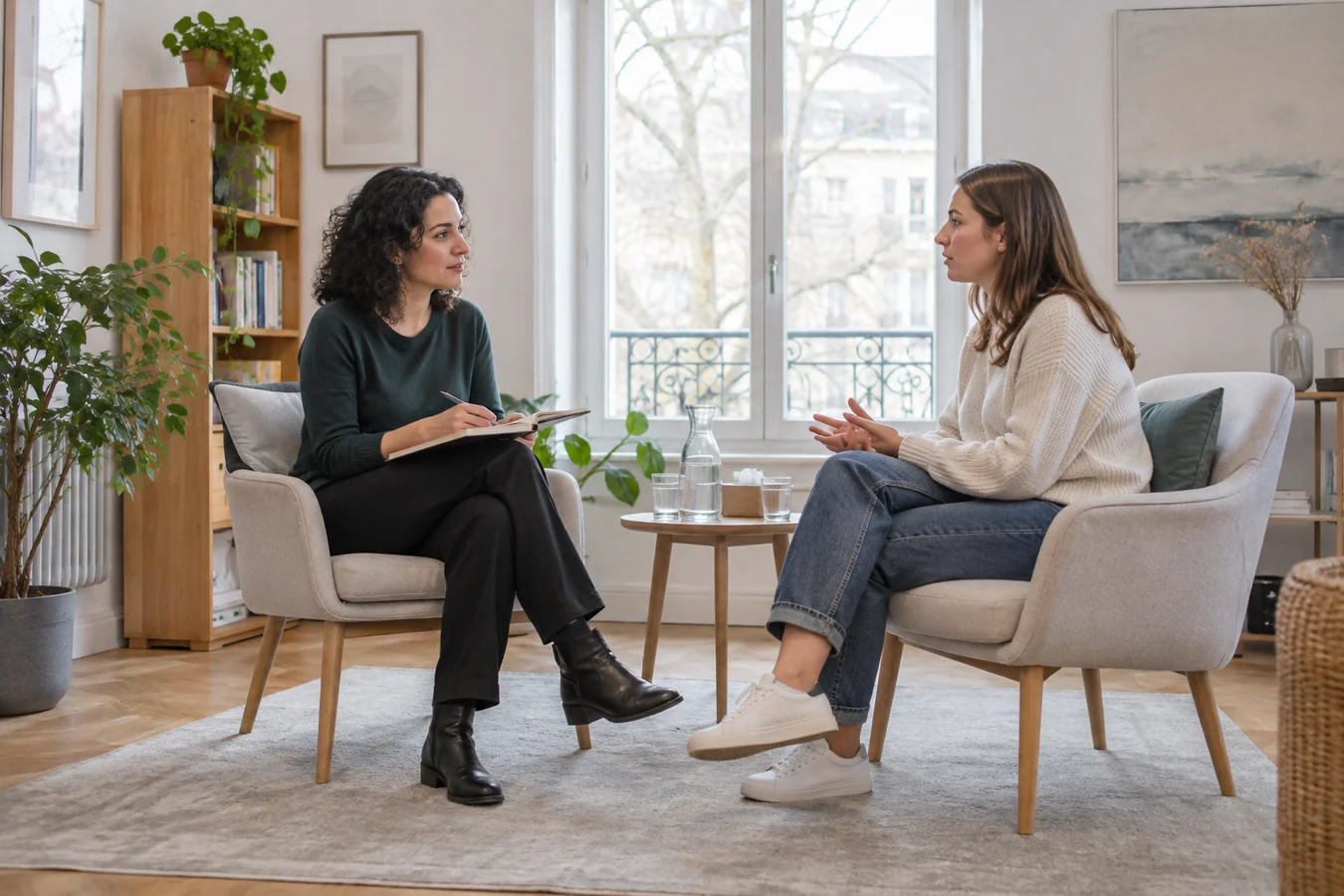
Oral. You hold a therapeutic conversation with a person playing a patient: you listen actively, reflect, ask gentle follow-up questions and explore the concern, always in clear everyday language.
Part 2 · Case documentation (Falldokumentation, 20 minutes)
In North Rhine-Westphalia, you write on the computer provided, with a German keyboard, or by hand. You document the content of the conversation: the concern, history, mental state findings, working diagnosis and next steps, in professional register and in reported speech.
Part 3 · Professional discussion with a psychotherapist (20 minutes)
Oral. You present the same case to a colleague, answer questions and explain your assessment, now in professional language.
The level: C2 with patients, C1 for documentation and colleagues
This is where it differs from the medical FSP, which is usually set at C1. For psychotherapy, the North Rhine-Westphalia chamber names two levels:
- In the conversation with patients: specialist German oriented to level C2 of the Common European Framework of Reference.
- In case documentation and professional discussion with colleagues: specialist German oriented to level C1.
It makes sense: in psychotherapy, language is the working tool. Hearing nuance, putting feelings into words and asking a sensitive question with care calls for the finest level.
The exam assesses listening comprehension and spoken and written expression. The information sheet makes clear that it focuses on language: you already bring your therapeutic expertise.
The competent body in your federal state
The licensing authority confirms the language requirements and who runs the exam. The procedure above and the C1 and C2 levels refer to North Rhine-Westphalia. In Bavaria, the rules of procedure (Verfahrensordnung) of the Psychotherapeutenkammer Bayern require specialist German oriented to level C2; the exam usually lasts 60 minutes, and the three areas, patient conversation, documentation and professional discussion, carry equal weight. Always prepare with the current requirements of your authority.
Fachsprachenprüfung, Fachsprachprüfung, Fachsprachentest: the chambers spell the name differently. The chambers of North Rhine-Westphalia and Bavaria and the chamber of the eastern states (Ostdeutsche Psychotherapeutenkammer) say “Fachsprachenprüfung”, the Lower Saxony chamber says “Fachsprachprüfung”, and the Berlin chamber’s information sheet calls it “Fachsprachentest”. In every case it is the specialist language exam on the way to the Approbation.
Application, fee and retakes: the North Rhine-Westphalia example
The information sheet of the North Rhine-Westphalia chamber describes the route; for your application, the state authority’s information applies. There, you apply to the Bezirksregierung Münster, the regional government in Münster, which refers you to the chamber. The chamber contacts you, proposes a date and sends the invitation and the fee notice. If the date does not suit you, you agree an alternative with the chamber.
The fee in North Rhine-Westphalia is €880.00, and the same for each retake. Retakes are unlimited. You always retake the whole exam, including parts you passed in an earlier attempt. Registration for a retake again goes through the Bezirksregierung Münster.
On the day of the exam, you identify yourself with an official photo ID.
The three registers of German in the exam
The same content exists in several registers, and each matches one part of the exam. The sentences are in German, with their meaning below:
| Patient conversation (part 1) | Professional discussion (part 3) | Documentation (part 2) |
|---|---|---|
| „Ich habe Herzrasen, und ich bekomme keine Luft.“My heart is racing and I can’t breathe. | „Er berichtet über anfallsartige Tachykardie und Dyspnoe.“He reports paroxysmal tachycardia and dyspnoea. | „Er schildert, sein Herz rase und er bekomme schwer Luft.“He describes that his heart races and he struggles to breathe. |
| „Ich habe zu nichts mehr Lust.“I don’t feel like doing anything any more. | „Die Patientin zeigt einen ausgeprägten Interessenverlust (Anhedonie).“The patient shows a marked loss of interest (anhedonia). | „Sie gibt an, sie habe zu nichts mehr Lust.“She states that she no longer feels like doing anything. |
| „Morgens ist alles am schlimmsten.“Mornings are the worst. | „Es besteht ein ausgeprägtes Morgentief.“There is a marked morning low. | „Sie berichtet, morgens sei alles am schlimmsten.“She reports that mornings are the worst. |
The rule runs through the whole exam: with the patient, you speak their language. Instead of „Sie leiden an Anhedonie“ (you suffer from anhedonia), you ask „Nichts macht Ihnen mehr Freude?“ (Nothing brings you joy any more?). In documentation and professional discussion, you speak and write in professional language.
Once you can switch confidently in both directions, you hold the linguistic core of the psychotherapy FSP.
What matters in the language
Four skills carry you through all three parts:
- Asking gently. A polite, indirect question such as „Dürfte ich Sie fragen, wie es dazu kam?“ (May I ask how this came about?) opens a conversation that runs against the clock.
- Reporting what the patient said. This is the backbone of the documentation: „Sie gibt an, sie habe …“ (She states that she has …), „Er berichtet, er sei …“ (He reports that he is …).
- Formulating the mental state findings. Phrases such as „Der Patient wirkt affektverflacht, scheint aber absprachefähig zu sein“ (The patient appears to have flattened affect but seems able to keep agreements) can be learned like vocabulary and give the written part a clear structure.
- Expressing a working diagnosis with nuance. Forms such as dürfte, könnte and müsste (is likely to, could, would have to) keep the statement precise and professional.
How to prepare for the psychotherapy FSP
A general German course takes you to a level. The exam also asks for something specific: mastering the same case three times in language. A preparation that trains this follows this order:
- One clinical picture after another. Depression, anxiety and panic, suicidality, obsessive-compulsive disorder, trauma, borderline, bipolar disorder, eating disorders, somatoform disorders, addiction, psychosis and adjustment disorder, each with its vocabulary and ICD-10 code.
- Holding the conversation. Active listening, reflecting and gentle follow-up questions, out loud and spoken.
- Documenting the same case. Case documentation and mental state findings, with a model answer for comparison.
- Presenting the case to a colleague. A case presentation with questions, the step that counts in part 3.
- Rehearsing against the clock, and often. A complete 60-minute run-through makes exam day familiar. Repeat it after every lesson and you arrive at the exam with routine.
The best time to start? While your recognition procedure is under way. You build your specialist German calmly during that time, and it is ready when the invitation arrives. A completed B2 is the right starting point; a specialist course then takes you up to C1–C2.
Frequently asked questions about the psychotherapy FSP
Who runs the exam in my federal state?
How does the Fachsprachenprüfung for psychotherapists work?
Fachsprachenprüfung or Fachsprachprüfung: which is correct?
What German level does the psychotherapy FSP require?
Is my knowledge of psychotherapy assessed?
How much does the FSP cost, and can I retake it?
What German level do I need to start preparing?
Is there an online course to prepare for the psychotherapy FSP?
Sources: Merkblatt „Fachsprachenprüfung bei der Psychotherapeutenkammer Nordrhein-Westfalen“, version of 07.11.2023 (ptk-nrw.de); Verfahrensordnung für Fachsprachenprüfungen der Psychotherapeutenkammer Bayern, version of 01.04.2024 (ptk-bayern.de); exam pages of the Psychotherapeutenkammer Niedersachsen (pknds.de), the Ostdeutsche Psychotherapeutenkammer (opk-info.de) and the Psychotherapeutenkammer Berlin (psychotherapeutenkammer-berlin.de), accessed 15.10.2026. Information for other federal states is published by the chamber there.
Keep reading
These articles continue along the same path:
← Back to the Magazine