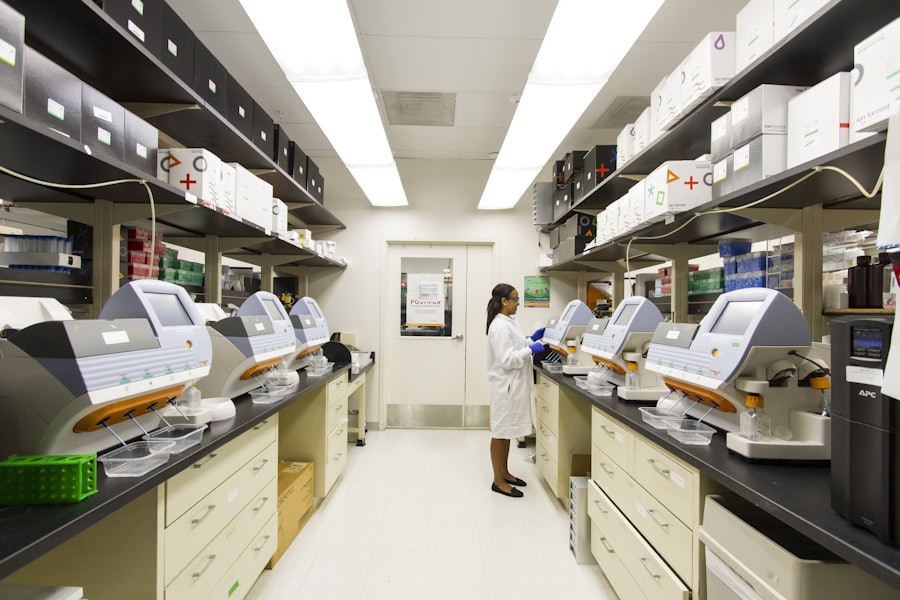
In many countries, validating and releasing laboratory results is the responsibility of the specialist physician in laboratory medicine. In Germany, this is done by the lab technologist themselves — independently, with full professional accountability. For international MTLs entering the German healthcare system, this difference is fundamental: it defines who you are on the team, what decisions you can make and what is expected of you from day one.
- The MTL in Germany: a new title, the same profession as always
- The 4 specialisation areas of the German clinical laboratory
- Day-to-day work in the laboratory: from sample to result
- Befundvalidierung: validating and releasing results — without a physician
- Kritische Werte: critical values and direct communication with the ward
- RiLiBÄK and quality control: the culture of traceability
- What surprises international MTLs most
- The language of the German laboratory
The MTL in Germany: a new title, the same profession as always
Since the reform of the healthcare training legislation in 2023, the official designation for laboratory technologists in Germany changed. The former MTLA (Medizinisch-technische Laborassistentin / Laborassistent) became MTL (Medizinische Technologin / Medizinischer Technologe für Laboratoriumsanalytik). It is a change of name — the profession, the competencies and the responsibilities remain the same.
In the German healthcare system, the MTL is the key specialist in the clinical laboratory. They work in hospitals, external diagnostic laboratories, research centres and specialist clinics. Training lasts 3 years, includes intensive placements in all 4 main areas and ends with a state examination.
The 4 specialisation areas of the German clinical laboratory
The work of the MTL in Germany is structured around four major areas. In hospital laboratories, the MTL rotates through or specialises in one or more of them:
Full blood count (Blutbild), differential white cell count, coagulation (PT, aPTT, fibrinogen, D-dimer), blood group.
Blood chemistry (glucose, electrolytes, liver enzymes, renal function), hormones, tumour markers, immunoassays.
Cultures, antibiograms, PCR, serology (ELISA, CLIA), parasitology, resistance detection.
Tissue processing (paraffin embedding), sectioning, staining (H&E, histochemistry, immunohistochemistry), cytology (cervical, sputum, fine needle aspiration).
Each area has its own procedures, specific equipment and technical vocabulary. Mastering the language of the German laboratory means knowing this terminology — not just in general, but within each speciality.
Day-to-day work in the laboratory: from sample to result
In most German hospital laboratories, the working day starts early. Samples from the night shift and the first morning draws are waiting. The typical process has several well-defined steps:
Quality control (Qualitätskontrolle) — before analysing any patient samples
The first task of the morning is not patient samples: it is the internal quality control. Before starting the analysers, control samples (Kontrollseren — control sera with known expected values) are processed. If the controls do not pass, the analyser does not run patient samples. This step is legally mandatory (RiLiBÄK) and all documentation is recorded.
Sample reception and processing (Probenverarbeitung)
Every sample arriving at the laboratory is assessed visually before analysis: is there haemolysis (Hämolyse)? Is the sample lipaemic (lipämisch) or icteric (ikterisch)? Is the volume sufficient? Is the request complete? An unsuitable sample can produce erroneous results — the MTL identifies and manages it (requesting a new sample, noting the incident, communicating it to the requester).
Analysis and plausibility check (Plausibilitätsprüfung)
Once a sample has been analysed, the result is not released directly. The MTL reviews it: is it consistent with the patient's previous values? Is it within the instrument's reference limits? Is there any discrepancy that requires repeating the analysis or requesting clarification? This plausibility check (Plausibilitätsprüfung) is a core part of the MTL's work and requires both clinical and technical judgement.
Befundvalidierung: validating and releasing results — without a physician
This is the difference that surprises international lab technologists most: in Germany, the MTL validates and releases (freigibt) laboratory results independently. There is no on-call physician who "approves" each result before it enters the clinical system.
Befundvalidierung (result validation) is the process by which the MTL confirms that a result is technically correct, analytically plausible and fit for clinical decision-making. Once validated, the MTL performs the Freigabe — literally "release" — and the result appears in the hospital information system (KIS, Krankenhausinformationssystem), where the treating physician can access it.
The complete process: from sample to available result
Sample received → Internal QC passed → Analysis performed → Plausibility check (Plausibilitätsprüfung) → MTL validates and releases (Freigabe) → Result visible in the HIS for the treating physician
In many other countries — Spain, France, much of Latin America, many Eastern European countries — this validation step is performed by the specialist physician in laboratory medicine (Laborarzt / Labormediziner). The technologist analyses, the physician validates. In Germany, the technologist does both.
It is 7:45 am. The full blood count of a post-surgical patient shows a haemoglobin of 6.2 g/dL. The MTL checks the quality control for that run (passed), confirms there is no haemolysis in the sample, and compares with the patient's previous value (9.1 g/dL yesterday). Critical value. The MTL calls the ward directly, communicates the result to the nurse in charge, records the call with the time and name of the recipient — and then releases (freigibt) the result in the system. The physician will see it as soon as they access the KIS.
This level of autonomy implies real professional responsibility. The German MTL is the final quality check before a result reaches the clinician. Their judgement matters — and the system recognises this.
Kritische Werte: critical values and direct communication with the ward
Kritische Werte (also called Panikangriffswerte or Alarmwerte — panic values or alarm values) are results so far outside the reference ranges that they require immediate clinical action. Each laboratory defines its own critical limits in line with national and international guidelines.
When the MTL detects a critical value, they act as follows:
- Technically verify the result (repeat if necessary, review the QC).
- Call the responsible physician or ward nursing staff directly — without intermediaries.
- Communicate the result verbally, repeat it for confirmation and document the call: time, name of the recipient, result communicated.
- Release (freigibt) the result in the system once communication is complete.
Examples of typical critical values: haemoglobin < 7 g/dL, potassium > 6.5 mmol/L, glucose < 2.8 mmol/L, troponin above the laboratory's alarm threshold, platelets < 20,000/µL.
RiLiBÄK and quality control: the culture of traceability
Quality in German clinical laboratories is governed by the RiLiBÄK (Richtlinien der Bundesärztekammer zur Qualitätssicherung laboratoriumsmedizinischer Untersuchungen — Guidelines of the German Medical Assembly for Quality Assurance in Laboratory Medicine). Compliance is mandatory for all laboratories performing analyses on human samples.
In practice, this means:
- Daily internal quality control: control samples before each patient run, with accepted limits and mandatory recording.
- Ringversuche (external proficiency testing): regular participation in accredited external controls. If a laboratory fails the Ringversuche, it may no longer report results for that measurand.
- Complete documentation: every analysis, every control, every incident and every calibration is recorded and auditable.
- Equipment maintenance and calibration: with records, dates and the signature of the person responsible.
For MTLs coming from systems with less formalised quality cultures, this can initially feel burdensome. But it is also what makes German laboratory results among the most reliable in Europe — and what gives the MTL a position of credibility within the clinical team.
What surprises international MTLs most
Lab technologists arriving in Germany from other healthcare systems tend to highlight the same differences:
More autonomy than expected
The independent validation and release of results is a responsibility that does not exist for the technologist in many countries. At first it can create uncertainty — can I make that decision on my own? In Germany, yes. And it is expected of you.
Direct communication with clinicians
In some systems, the technologist passes results to the laboratory physician, who then communicates with the ward. In Germany, the MTL calls the ward nursing staff or the responsible physician directly for critical values. That communication must be clear, precise and professional — in German.
QC as routine, not exception
Starting the day with quality control before any patient sample may come as a surprise. In Germany it is not optional — it is the procedure. Anyone who skips it is acting outside the standard.
The new title (MTL vs. MTLA)
Technologists trained before 2023 hold the MTLA title. Those trained afterwards hold the MTL title. Both are equivalent in competencies. In daily practice, colleagues in Germany use both terms interchangeably — but on a CV and in official documentation, the exact title matters.
The language of the German laboratory
The Fachsprachprüfung (FSP — specialist language examination) required by many federal states (Länder) for professional recognition is not a general grammar test — it is proof that you can communicate safely in real clinical situations. For the MTL, this includes:
- Describing analytical procedures to a new colleague or a student.
- Communicating critical values (Kritische Werte) to the ward clearly and in a structured way.
- Explaining to the requesting physician why a sample is unsuitable for analysis.
- Writing an internal report about an equipment incident or a QC non-conformity.
- Participating in team meetings and shift briefings.
Each of these situations has its own vocabulary, characteristic sentence structures and professional expectations. General German is not enough — the KlinikDeutsch MTL language course trains exactly these situations, with an AI tutor available to practise whenever you want.
| Aspect | Germany | Common difference from other countries |
|---|---|---|
| Validation of results | The MTL validates and releases (Freigabe) independently | In many countries, the laboratory physician validates before release |
| Critical values | The MTL calls the ward or responsible physician directly | Often mediated by the laboratory physician or shift supervisor |
| Quality control | Mandatory RiLiBÄK, accredited Ringversuche, daily records | QC variable; less formalised in many systems |
| Professional title | MTL (from 2023), previously MTLA | Lab technician, TLM, clinical biologist, BMA, etc. |
| Unsuitable sample | The MTL decides whether to reject it and communicates directly with the requester | In some systems this step is managed by the laboratory physician |
| Legal responsibility | Personal responsibility of the MTL for the validation they sign off | Responsibility more shared or delegated to the physician in many countries |
Test your German in a real workplace conversation
Speak a few minutes of German — a real situation from your professional routine, free and without signing up. The conversation is in German, exactly like the exam. You instantly see what you still need.
Or go straight to the full course.