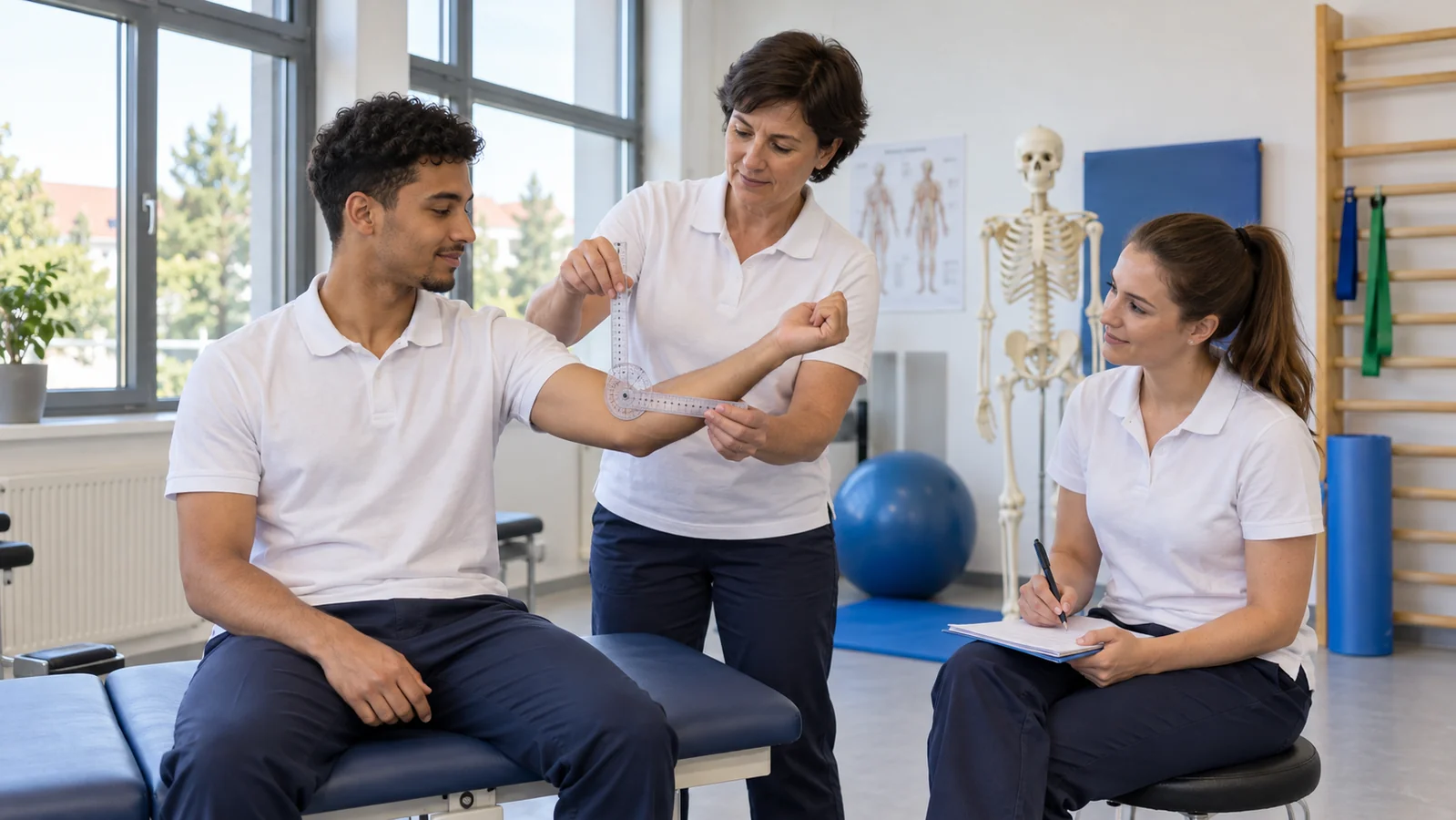
What does a patient want to achieve in everyday life? How do they move, and how will you support them? Germany’s vocational physiotherapy training connects classroom learning and patient work over three years. Its structure also helps you describe an overseas qualification clearly for recognition.
Three years connecting teaching and clinical practice
The school-based pathway regulated by the MPhG takes place at state-recognised schools and lasts three years. It includes at least 2,900 hours of theoretical and practical teaching and 1,600 hours of practical training: 4,500 hours combined. Teaching includes hands-on classroom work as well as theory.
The subjects a physiotherapist studies
The table shows the minimum allocation in the official curriculum. It connects body sciences, assessment, treatment techniques and their clinical application. For example, anatomy supports explaining and assessing movement; assessment findings help you develop a functional goal and treatment plan.
| Subject or subject group | Hours |
|---|---|
| Professional law and state organisation | 40 |
| Anatomy | 240 |
| Physiology | 140 |
| General pathology | 30 |
| Specialised pathology | 360 |
| Hygiene | 30 |
| First aid and bandaging | 30 |
| Applied physics and biomechanics | 40 |
| Communication, documentation and professional literature | 20 |
| Psychology, pedagogy and sociology | 60 |
| Prevention and rehabilitation | 20 |
| Training theory | 40 |
| Movement studies | 60 |
| Movement education | 120 |
| Physiotherapy assessment and examination techniques | 100 |
| Physiotherapy treatment techniques | 500 |
| Massage therapy | 150 |
| Electrotherapy, light therapy and radiation therapy fundamentals | 60 |
| Hydrotherapy, balneotherapy, thermal and inhalation therapies | 60 |
| Application of physiotherapy in clinical areas | 700 |
| Hours allocated across subjects | 100 |
| Total theoretical and practical teaching | 2900 |
How clinical placement hours are allocated
The 1,600 practical hours involve patients in hospitals or other suitable medical facilities. The regulation specifies seven areas, an additional allocation across them and hours in other facilities or educational visits. Each rotation provides a different setting for communication, goals and observation.
| Placement area | Hours |
|---|---|
| Surgery | 240 |
| Internal medicine | 240 |
| Orthopaedics | 240 |
| Neurology | 240 |
| Paediatrics | 160 |
| Psychiatry | 80 |
| Gynaecology | 80 |
| Hours allocated across the seven areas | 240 |
| Other facilities and educational visits | 80 |
| Total practical training | 1600 |
The state examination and entry requirements
Training ends with a state examination, the Staatsexamen, with written, oral and practical parts. The MPhG specifies health suitability and educational entry routes: a Realschulabschluss or equivalent education, another qualifying ten-year school pathway described in the law, or at least two years of vocational training after a Hauptschulabschluss. The school specifies the documents required.
Realschulabschluss and Hauptschulabschluss are German school qualifications. For overseas schooling, ask the school how to demonstrate equivalence.
Physiotherapist and medical massage practitioner: two qualifications
Masseur und medizinischer Bademeister is a separate regulated healthcare profession, described here as a medical massage and physical-therapy practitioner. Within this professional title, Bademeister refers to therapeutic bathing and related physical treatments. Training includes massage, exercises linked to these methods and physical applications such as water, heat and electrotherapy.
The standard pathway includes two years of school, with 2,230 hours of theoretical and practical teaching and 800 hours of practical training. After the state examination, there is a further six months of supervised practical work. The 800 hours belong to the school programme; the later six months are an additional stage.
Both professions work with patients and physical treatments. Physiotherapy training has its own emphasis on functional assessment, movement and treatment techniques, alongside massage and physical modalities. Medical massage training concentrates on massage and the physical treatments in its professional profile. Each title has its corresponding professional authorisation.
How to use the training plan for your next step
Make your training documents clear by separating subjects, teaching hours, clinical placements and professional experience. Record the area, facility, dates and documented tasks for each placement. This connects your training with the categories in the German programme. The responsible authority assesses your qualification and determines the recognition procedure for your case.
For a conversation about your experience, prepare concrete examples: a patient group, your assessment, a goal and how you documented progress. In the free consultation we help organise your German and the next step in your professional plans.
„Während meiner Ausbildung habe ich praktische Erfahrung in der Orthopädie gesammelt.“
During my training, I gained practical experience in orthopaedics.
Frequently asked questions
How many hours does vocational physiotherapy training include?
The standard three-year pathway includes at least 2,900 hours of theoretical and practical teaching and 1,600 hours of practical training: 4,500 hours combined.
How is medical massage training organised in Germany?
The standard pathway includes two years of school, with 2,230 teaching hours and 800 practical-training hours. The state examination is followed by six months of supervised practical work.